
Artificial Intelligence Timeline: Revolution from the Start
The Artificial Intelligence Timeline is presented through images and text to help readers explore the history of Artificial Intelligence. Understanding the past helps us better interpret today’s advancements and anticipate future developments.
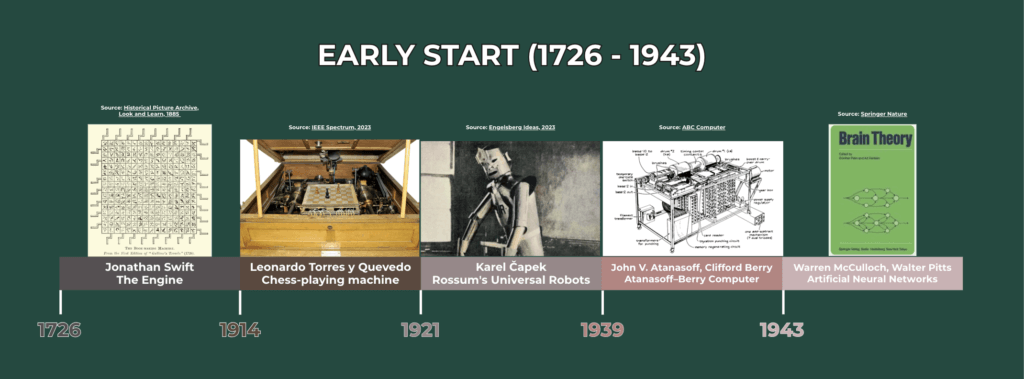
The idea of artificial intelligence was introduced in 1726 by Jonathan Swift. In his work he described “The Engine”. This is a large mechanical contraption designed to assist scholars in generating new ideas, sentences, and books. This concept resembles what we know call algorithmic text generation. Modern AI tools generate coherent text by combining words and ideas based on algorithms.
Artificial Intelligence Timeline: Beginnings
Early mechanical intelligence
- 1914 - Spanish engineer Leonardo Torres y Quevedo demonstrated the first automated chess-playing machine. One of the earliest examples of machines performing intelligent tasks.
- 1921 - Rossum’s Universal Robots premiered in London, written by Karel Čapek. This play introduced the word “robot”. Later it became the standard term for mechanical or artificial beings created to perform tasks. It was the first time humanoid machines were strongly associated with human-like labor.
Early computer science and neural concepts
- 1939 - John Vincent Atanasoff and his student Clifford Berry developed the Atanasoff-Berry Computer (ABC) at lowa State College. It was one of the earliest digital electronic computers and an important milestone in American computer science.
- 1943 - Warren McCulloch and Walter Pitts published “A Logical Calculus of the Ideas Immanent in Nervous Activity.” This work introduced the idea that the brain could be understood as a computational system. Forming the conceptual foundation of artificial neural networks. This research later inspired computer systems designed to simulate brain-like process through neural networks and deep learning.
Artificial Intelligence Timeline: Steps Further
1950 - 1980: Foundations of modern AI
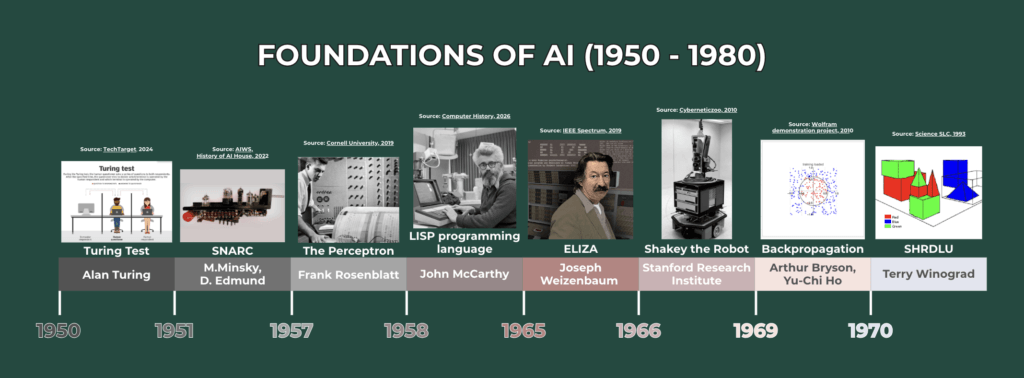
During this Artificial Intelligence Timeline period, the foundations of modern AI research were established.
- 1950 - Alan Turing proposed the Turing Test. A method for evaluating whether a machine can demonstrate intelligent behavior comparable to a human.
- 1951 - Marvin Minsky and Dean Edmunds built SNARC (Stochastic Neural Analog Reinforcement Calculator). One of the first artificial neural networks designed to simulate the behavior of a rat navigating a maze.
- 1952 - Allen Newell and Herbert A. Simon developed influential programs that attempted to mimic human problem-solving abilities using computational methods.
- 1957 - Frank Rossenblatt developed the Perception, on early artificial neural network capable of pattern recognition.
- 1958 - John McCarthy created the programming language LISP programming language. Designed formalizing algorithms and symbolic reasoning.
- 1959 - Arthur Samuel pioneered the concept of machine learning by developing a program that improved its performance through experience.
- 1965 - Joseph Weizenbaum developed ELZA, one of the earliest programs capable of simulating conversation using natural language.
- 1965 - Edward Feigenbaum, Bruce Buchanan, Joshua Lederberg and Carl Dierassi developed DENDRAL at Stanford University. This is one of the first expert systems used to assist chemists in hypothesis formation.
- 1966 - Shakey the Robot was developed at Stanford Research Institute. It became the first mobile robot capable of reasoning about its own actions.
- 1969 - Arthur Bryson and Yu-Chi Ho introduced backpropagation, a key method for training neural networks.
- 1970 - Terry Winograd created SHRDLU, a pioneering natural-language understanding program.
- 1972 - Stanford University developed MYCIN, an early expert system used to assist doctors in diagnosing bacterial infections.
Artificial Intelligence Timeline: Rapid Progress
1980-2000: AI research and early digital assistants
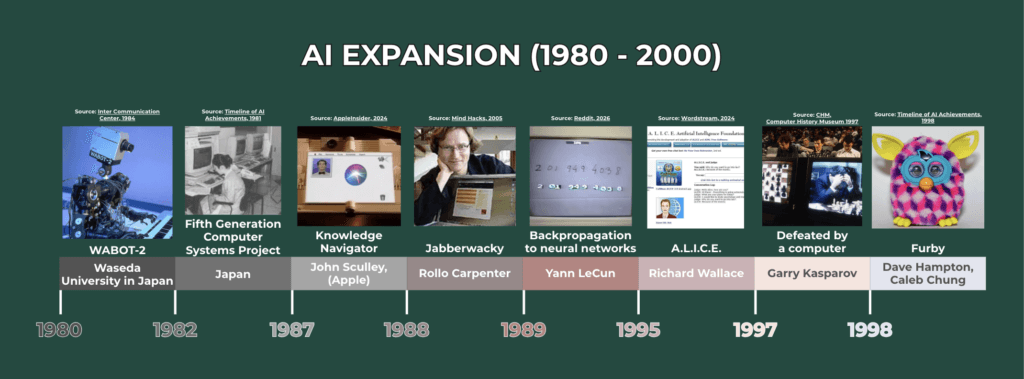
- 1980 - WABOT-2, developed at Waseda University in Japan, became one of the first humanoid robots. Designed to perform as a musician.
- 1982 - Japan launched the Fifth Generation Computer Systems Project (FGCS). Aiming to create machines capable of advanced natural land+guage processing and reasoning.
- 1984 - Roger Schank and Marvin Minsky warned about an approaching AI Winter. They were predicting a decline in research funding due to inflated expectations.
- 1987 - John Sculley, CEO of Apple, presented the Knowledge Navigator concept. A vision of digital assistants helping users access networked information.
- 1988 - Rollo Carpenter developed Jabberwacky, a chat bot designed to simulate entertaining human conversations.
- 1989 - Yann LeCun and his team at AT&T Bell Labs applied backpropagation to neural networks. Mean for recognizing handwritten ZIP codes.
- 1995 - Richard Wallace created A.L.I.C.E., a chat bot designed to engage in more advanced natural-language conversations.
- In 1997 - the chess world champion Garry Kasparov was defeated by a computer - IBM Deep Blue.
- 1998 - Dave Hampton and Caleb Chung created Furby. One of the first interactive robotic toys capable of responding to touch, sound, and light.
Artificial Intelligence Timeline: The AI Revolution
2000-2020: Rise of modern AI
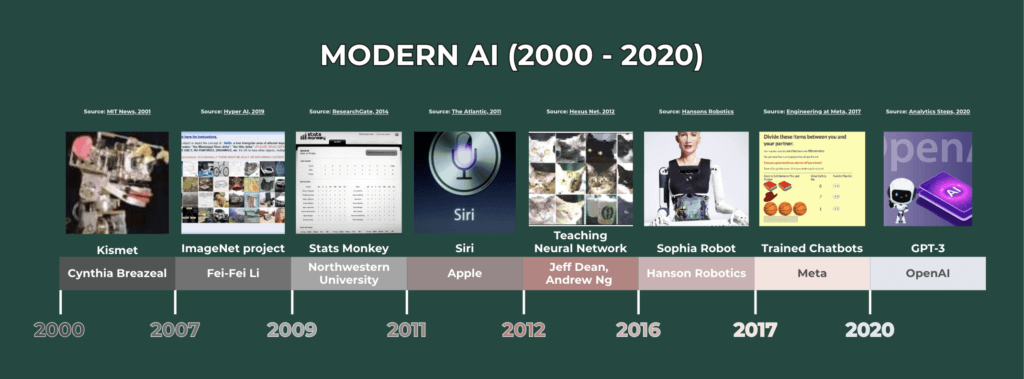
- 2000 - Cynthia Breazeal developed Kismet, a robot capable of recognizing and responding to human emotions.
- 2007 - Fei-Fei Li initiated the ImageNet project, one of the largest image dataset used to train computer vision systems.
- 2009 - Researchers at Northwestern University created Stats Monkey, a system capable of automatically generating sports news reports.
- Apple launched Siri in 2011, a voice assistant integrated into iOS.
- 2012 - Jeff Dean and Andrew Ng trained a large neural networking using millions of images from YouTube videos.
- 2012 - Researchers at the University of Toronto. They achieved a breakthrough using convolutional neural networks in the ImageNet Large Scale Visual Recognition Challenge.
- Google Deep Mind introduced AlphaGo in 2016, demonstrating the power of deep learning in complex strategic games.
- 2016 - Hanson Robotics introduced Sophia robot, a humanoid robot capable of recognizing faces and holding conversations.
- 2017 - Researchers at Meta Platforms trained chat bots capable of negotiating with each other.
- In 2020, OpenAI released GPT-3. A powerful language model capable of generating human-like text, writing code, translating languages, and engaging in conversation.
The Artificial Intelligence Timeline will continue to evolve over time. Welcome to the age of technology.
🎧 Prefer listening? Press play to hear this page.
*Artificial Intelligence Timeline Content Source:
*Artificial Intelligence Timeline Images Sources:
- Historical Picture Archive, Look and Lear, 1885
- IEEE Spectrum, 2023
- Engelsberg Ideas, 2023
- ABC Computer
- Springer Nature
- TechTarget, 2024
- AIWS, History of AI House, 2022
- Cornell University, 2019
- Computer History, 2026
- IEEE Spectrum, 2019
- CyberneticZoo, 2010
- Wolfram demonstration project, 2010
- Science SLC, 1993
- Inter communication Center, 1984
- Timeline of AI Achievements, 1981
- AppleInsider, 2024
- Mind Hacks, 2005
- Reddit, 2026
- Wordstream, 2024
- CHM, Computer History Museum, 1997
- Timeline of AI Achievements, 1998
- MIT News, 2001
- Hyper AI, 2019
- ResearchGate, 2014
- The Atlantic, 2011
- Hexus Net, 2012
- Hansons Robotics
- Engineering at Meta, 2017
- Analytics Steps, 2020

[…] transformative events have shaped human. It is represented in the history timeline, AI is no longer a futuristic concept-it is a reality. Society must adapt to and embrace the ways […]
Couldn’t agree more.